
What Is Volumetric Weight?
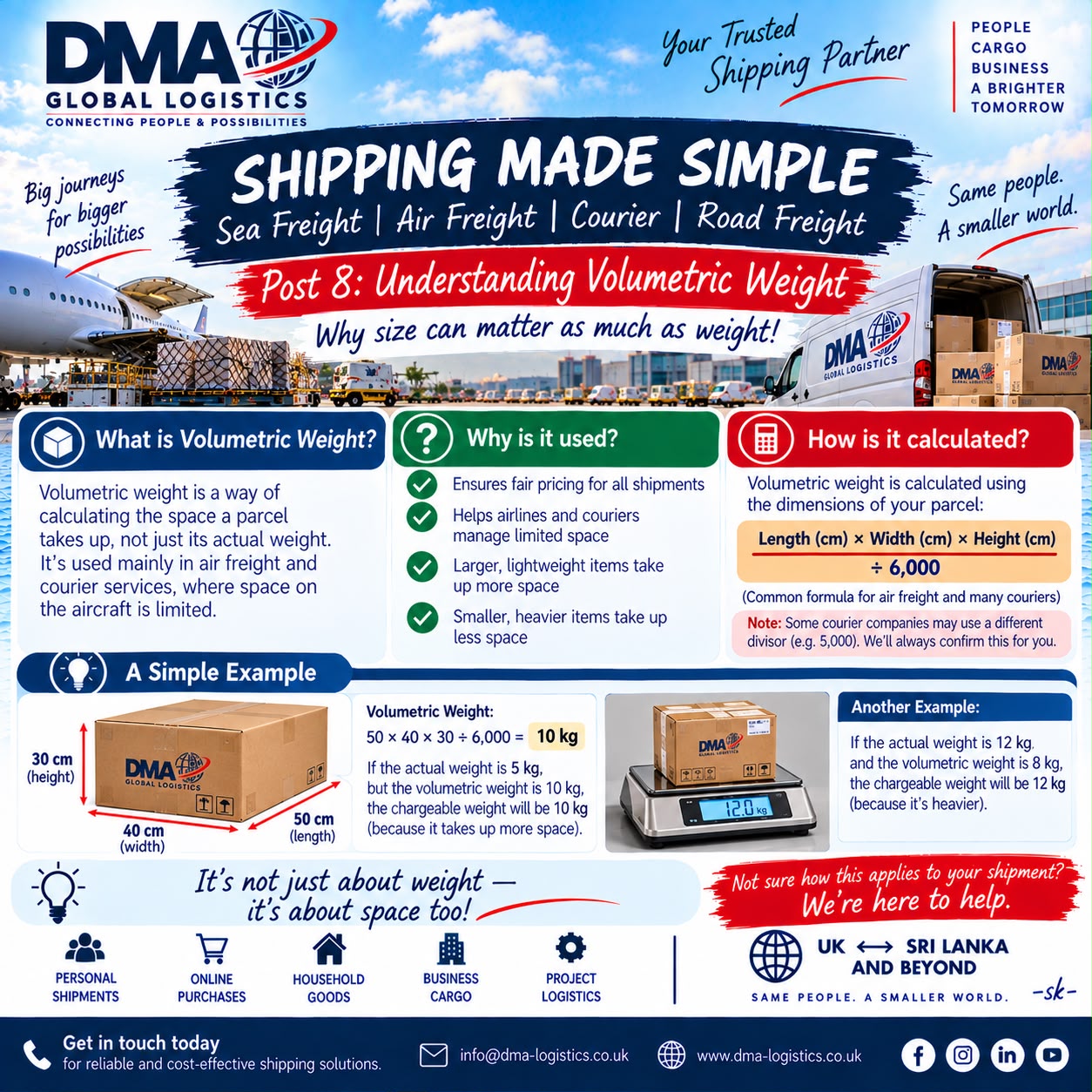
Volumetric weight, also called dimensional weight, is a way of measuring how much space a shipment takes up during transport. It is used mainly in air freight and courier services because space on aircraft and delivery networks is limited.
This means a large but lightweight parcel may be charged based on the space it occupies rather than its actual scale weight. In simple terms, it is not only the kilos that matter. The parcel size matters too.
Why Is Volumetric Weight Important?
Volumetric weight helps logistics providers price shipments fairly and manage available cargo space more efficiently.
How Is Volumetric Weight Calculated?
For many air freight and courier shipments, the volumetric weight is calculated using the package dimensions in centimetres.
Standard example formula
Some providers may use a different divisor such as 5,000 depending on the service or courier. DMA will confirm the applicable formula before finalising your shipment.
A Simple Volumetric Weight Example
Example parcel size
Let’s say your parcel dimensions are:
- Length: 50 cm
- Width: 40 cm
- Height: 30 cm
If we use the 6,000 divisor:
50 × 40 × 30 = 60,000
60,000 ÷ 6,000 = 10 kg
Compare with actual weight
If the parcel actually weighs 5 kg, but the volumetric weight is 10 kg, the shipment would normally be charged at 10 kg because it takes up more space.
If the actual weight were 12 kg and the volumetric weight were 10 kg, the shipment would normally be charged at 12 kg.
Key Weight Terms You Should Know
Actual Weight
The real weight measured on a weighing scale.
Volumetric Weight
The weight calculated from the package dimensions using a divisor.
Chargeable Weight
The higher value between the actual weight and the volumetric weight.
Divisor
The number used in the formula, such as 6,000 or 5,000, depending on the service.
When Does Volumetric Weight Matter Most?
| Shipment Type | Why Volumetric Weight Matters |
|---|---|
| Large lightweight boxes | They may not weigh much, but they take up more aircraft or vehicle space. |
| Gift parcels and personal shipments | Clothing, soft toys, snacks or mixed parcels may be bulkier than expected. |
| E-commerce orders | Retail shipments often use carton packaging that increases overall dimensions. |
| Courier services | Courier pricing often uses dimensional weight for faster, door-to-door shipments. |
| Air freight consignments | Aircraft space is limited, so both size and weight affect the shipment cost. |
Tips to Manage Volumetric Weight
- Use packaging that fits the contents properly and avoid oversized boxes.
- Remove empty space where possible by packing items neatly and securely.
- Measure each parcel accurately before requesting a quotation.
- Ask whether consolidation or repacking may help reduce chargeable weight.
- Share both parcel dimensions and actual weight with the DMA team.
What Information Should You Send to DMA?
To estimate shipping charges accurately, please share as much of the following as possible:
- Number of boxes or packages
- Length, width and height of each package
- Actual weight of each package or total shipment weight
- Type of goods being shipped
- Collection location and delivery destination
- Preferred service type such as air freight or courier
This helps our team determine the likely chargeable weight and recommend the most suitable shipping option.
We’re Here to Help
If you are unsure how volumetric weight applies to your parcel, DMA Logistics can guide you through the calculation and help you choose the right shipping method from the UK to Sri Lanka and beyond.